


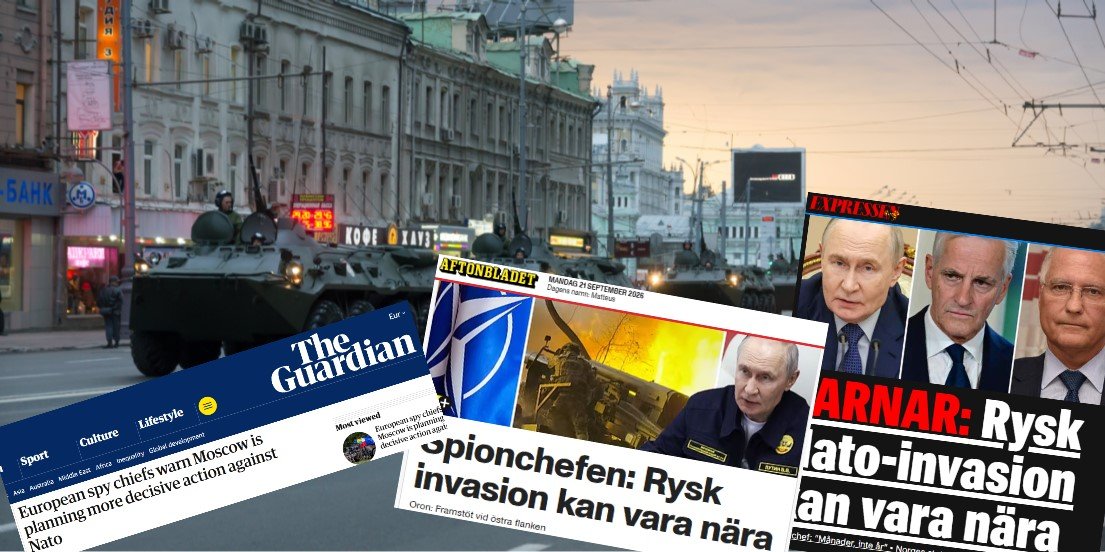
Russia could attack a NATO country within just a few months, according to warnings that have received widespread attention in the Swedish media. But if you look at the intelligence chiefs’ own statements, the picture is less dramatic: an invasion is described as a possibility—while Latvia’s intelligence chief says there are no signs of an imminent attack.
Aftonbladet concludes that a ”Russian invasion may be imminent,” while The Express reports that an invasion of a NATO country could take place within months. The articles are based on The Guardian's interviews with European intelligence chiefs, in which several possible forms of Russian escalation are discussed.
The words behind the dramatic headline
The Head of the Czech Republic's Intelligence Service Michal Koudelka says that a Russian operation against NATO is possible and that such a scenario could become a reality within months rather than years. But he is not just talking about an invasion; he also mentions false-flag provocations and large-scale influence operations.
– That's possible. It could involve a limited military offensive, false-flag provocations, or a large-scale influence campaign.
At the same time, The Guardian reports that neither Koudelka nor Latvia's intelligence chief Normunds Mežviets wanted to discuss what specific intelligence information lies behind the reports of Russian planning. The publicly available evidence presented therefore does not establish that Moscow has decided to launch an invasion within months.
Intelligence Chief: No Signs of an Imminent Attack
Mežviets offers a much more cautious assessment. He sees signs that Russia is preparing more aggressive actions in Europe, but says it remains unclear whether there are concrete plans or whether these actions are primarily intended to instill fear and uncertainty in the West.
– We see no signs of an imminent attack.
Baltic officials are also concerned that talk of an imminent invasion could fuel the very fear that Russian disinformation campaigns are trying to create. The Guardian reports that politicians in the region have sought to tone down alarmist messages because panic risks harming both communities and economies.
The threat is greater than the risk of invasion
At the same time, intelligence chiefs are warning of sabotage, attacks on railways and the defense industry, and operations targeting support for Ukraine. These are concrete security threats that, according to their assessments, could increase, but they are not the same as a conventional Russian war of invasion against NATO.
The main point behind the headlines is therefore important: Koudelka warns of what could happen within months, while Mežviets explicitly states that he sees no signs of an imminent attack. The publicly reported information indicates that there may be a threat—but does not confirm that a Russian invasion is imminent, which is nonetheless what the media is heavily promoting.


The enemy never came.
They were already right here among us.
So, we're going to see and hear a lot of fake news reports about that favorite ”external enemy” (which doesn't exist) in the future.
Especially now that traditionally moderate parties such as the AfD are making rapid gains.
Those left-wing nutcases don't give a damn about spirals, ha ha.
Write a story about it. That would be fun.
The usual scare tactics.
Russia has its hands full with Ukraine.
As bad as this country is, I wouldn't care if Russia came to visit, but maybe it would wake people up—because as things stand now, most people seem to be asleep.